STEM, science, and research
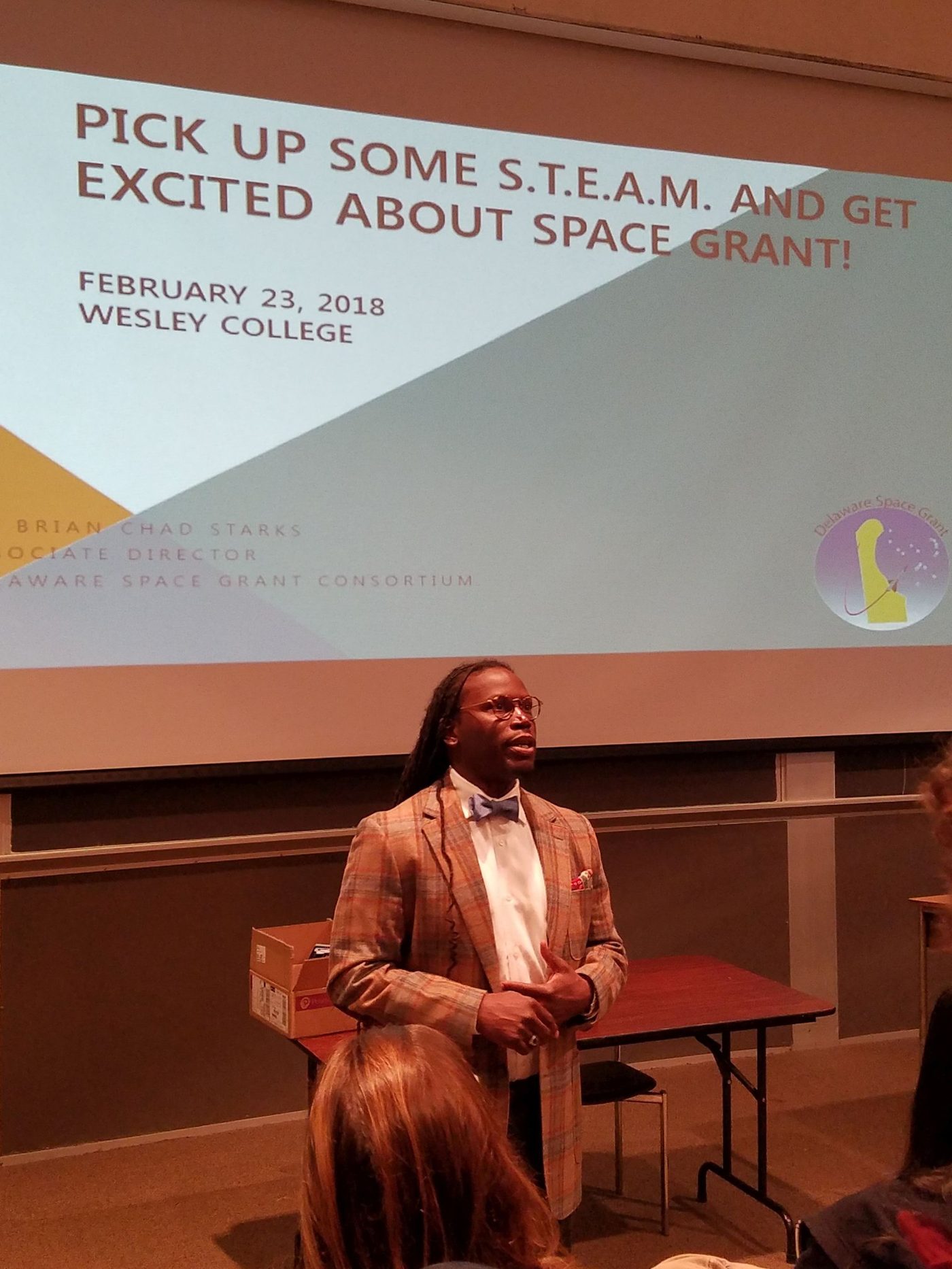
For research universities, STEM programs, consortia, and scientific societies working on who gets into the field and who stays. Dr. Starks spent seven years as Associate Director of Delaware Space Grant, has worked with NASA Space Grant consortia across the country, and helped build an NSF-funded leadership program for the geosciences on the Be The Messenger Framework.
What the work addresses
STEM programs want more students from underrepresented groups, and many have tried to recruit them. Dr. Starks comes at the problem as a social scientist. He looks at the culture of the department or the lab, at how faculty and mentors see the students in front of them, and at the barriers that discourage people from choosing the field or staying in it. Then he asks the people in charge to do the self-reflection first.
His argument, published with William H. Matthaeus in the Journal of STEM Education, is that students' perception of their own suitability and eligibility shapes whether they enter STEM and stay, and that faculty members, whatever their own background, are the messengers of that eligibility.
The research behind it
The Be The Messenger Framework has been applied in STEM programs and published in peer-reviewed journals.
Journal of STEM Education, 2018
"STEM Recruitment and Beyond: The Messenger is the Medium," with William H. Matthaeus. The authors report that their method substantially increased applications and awards for racial and ethnic minority students from 2012 to 2014. Read the article (PDF)
Oceanography, December 2023
"Increased Resilience and Accountability Through 'Shipboard' Experiences," on ALL-ABOARD, a National Science Foundation funded program that built intergenerational teams of diversity leaders in the geosciences. The program used the Be The Messenger Framework in all of its parts, and Dr. Starks is a co-author. Read the article (PDF)
Where the Framework came from
Dr. Starks holds a PhD in criminology from the University of Delaware, where his research centers on law, inequality, and the connections between law, race, crime, and justice. As a PhD student he founded the Minority Mentor Lecture Series, which the university still hosts, and he later served as Associate Director of Delaware Space Grant.
His work in STEM and research
Space Grant, an NSF-funded geoscience initiative, scientific societies, and research universities.
- April 2024University of Connecticut, Department of Molecular and Cell Biology
Keynote and facilitated dialogue with graduate students and faculty.
- June 2022Woods Hole Oceanographic Institution
"Tell the Truth About Independence in America."
- 2021 to 2022ALL-ABOARD, an NSF-funded geoscience initiative
A yearlong program built on the Be The Messenger Framework: nine webinars and an in-person retreat. The four intergenerational geoscience teams, with members from undergraduates to deans, came from West Virginia University, Coastal Carolina University, Salisbury University, and the University of South Florida. Co-author of the Oceanography article on it.
- 2021Pennsylvania Space Grant Consortium
Consultant, January to March 2021.
- 2013 to 2020Delaware Space Grant, University of Delaware
Associate Director, building programs to increase the representation of racial and ethnic minorities in Space Grant.
- March 2020HBCU-UP/CREST PI/PD Meeting, Washington, D.C.
"Be The Messenger of Social Justice in STEM."
- 2015 to 2019Space Grant consortia and colloquia
Virginia Space Grant's IN-STEP program, the Wisconsin Space Conference, the Mid-Atlantic Space Grant Consortia meeting, and Delaware Space Grant colloquia at the University of Delaware, Wesley College, and Wilmington University.
- September 2019Indiana Space Grant Colloquium
"Diversity Strategic Planning" and "Being the Space Grant's Messenger: Increasing Minority Representation in STEM," for the consortium housed at Purdue University.
- June 2019Woods Hole, Massachusetts
"STEM Recruitment and Beyond: The Messenger is the Medium," at the conference Optimizing the Research Intern Experience to Build Inclusion and Diversity in the Geosciences Workforce.
- December 2018American Geophysical Union, Fall Meeting, Washington, D.C.
"The Sociology of Recruitment and Retention of Underrepresented Groups in STEM: The Role of Faculty Members."
- September 2017National Council of Space Grant Directors, Grand Forks, North Dakota
Diversity strategic planning workshop at the fall meeting.
- March 2017National Council of NASA Space Grant Directors, Crystal City, Virginia
Workshop, "Being the Messenger: Implicit Bias."
Organizations he has worked with



- Delaware Space Grant Consortium
- Indiana Space Grant Consortium
- Wisconsin Space Grant Consortium
- Pennsylvania Space Grant Consortium
- The NASA Space Grant network
- Woods Hole Oceanographic Institution
- American Geophysical Union
- ALL-ABOARD, an NSF-funded geoscience initiative, with teams from West Virginia University, Coastal Carolina University, Salisbury University, and the University of South Florida
His work with these organizations includes consulting, speaking, training, academic and staff positions, leadership roles, research collaborations, and community service. A name on this list is not an endorsement.
From the people who brought him in
"Working with Professor Starks, or Chad as we call him, has been an enlightening and productive experience for me and for our statewide educational consortium. Chad provides motivation and direction, and has professionals talking about social inequality in a constructive way, where the same people were reluctant earlier to even touch these issues."
"I first saw Chad when he delivered one of the most compelling presentations about broadening the participation of minoritized students in STEM that I had ever heard."
"What I appreciate most is B. Chad's ability to ask the questions that matter most, the ones we often avoid asking ourselves."
How STEM and research institutions work with him
-
Keynotes and colloquia
Meetings, institutes, conferencesFor society meetings, consortium colloquia, and STEM institutes, the way he has spoken for AAC&U and the American Geophysical Union.
-
Diversity strategic planning
Consortia, programs, departmentsPlanning workshops for directors and leadership teams, like the one he led for the National Council of Space Grant Directors.
-
STEM access programs
One, three, and five daysStructured programs that support inclusive STEM environments, stronger student pathways, and institutional strategy.
-
Partnership on funded projects
Program design and evaluationA social science partner for grant-funded programs, the role he played on ALL-ABOARD.
One Framework, applied to STEM and research
Every engagement is built on the Be The Messenger Framework: four constructs, and the Messenger Method that runs underneath them. The Framework stays the same from one field to the next. What changes is how it is applied to the specific challenges, culture, professional responsibilities, and institutional conditions of the people in the room.
- IdentityWho you are
- CultureWhere you come from
- DiversityWhat connects us
- RespectHow you show up
The Messenger Method: Self-Reflection, Self-Awareness, and Self-Consciousness.
Request a proposal
Tell us about the program, the people it serves, and your timeline. We will come back with a shape for the engagement.
- Your request goes to Dr. Starks' office.
- We reply with availability and set up a short call to shape the engagement.
- You get a proposal, a W-9, and anything else your sponsored programs office needs.
Rather talk first? Book a training consultation or a keynote and speaking call.
Prefer email or phone? info@brianchadstarks.com or 434-329-9002.